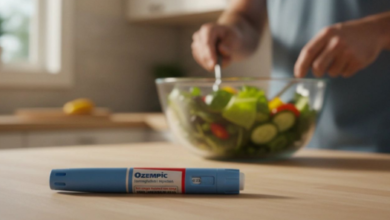
If the question is which reliably takes weight off, the honest answer is the approved GLP-1 drugs, semaglutide and tirzepatide. They have large randomized trials showing double-digit percentage weight loss. The wider category marketed as peptides for weight loss, meaning unapproved research compounds, mostly lacks human evidence of any comparable effect. So the two are not evenly matched, and treating them as equivalent options does a disservice to anyone deciding what to actually take.
Why is the word peptide so confusing here?
A peptide is just a short chain of amino acids. That definition covers a huge range of molecules, including the GLP-1 drugs themselves. Semaglutide and tirzepatide are peptides. So when someone advertises peptides for weight loss, the label is technically true but practically misleading, because it lumps rigorously tested medicines together with compounds that have almost no clinical data behind them.
In everyday use, people asking about peptides usually mean the second group: substances sold through wellness channels, sometimes labeled for research use only, promoted for fat loss, muscle, or recovery. The problem is not that these molecules are inherently fake. It is that the human trials establishing whether they help you lose weight, and at what safety cost, largely do not exist. That gap is the whole story.
What do the GLP-1 trials actually show?
This is where the evidence is genuinely strong. In SURMOUNT-1, adults with obesity or overweight received tirzepatide or placebo for 72 weeks, and those on the 15 mg dose lost roughly 20.9 percent of body weight on average, a figure that would have looked implausible for a drug a decade ago. The finding held up in a separate population in the SURMOUNT-CN trial in Chinese adults, where tirzepatide again produced large mean reductions against placebo.
Head-to-head data help too. A comparison of semaglutide and tirzepatide for weight loss in adults with overweight or obesity found tirzepatide produced greater average reduction, which fits the individual trial patterns rather than contradicting them. And the benefits reach beyond the scale. A trial of tirzepatide for obstructive sleep apnea and obesity showed improvement in sleep apnea severity, which matters because weight-related conditions, not the number on a scale, are what harm health.
How do the two categories compare on the things that matter?
| Factor | Approved GLP-1 drugs | Marketed research peptides |
|---|---|---|
| Human trial evidence | Large randomized trials with weight endpoints | Sparse or absent for weight loss |
| Regulatory status | FDA-approved for weight management | Generally not approved for this use |
| Typical weight change | Roughly 15 to 21 percent in trials | Not established in people |
| Known safety profile | Documented, mostly gastrointestinal effects | Poorly characterized |
| Prescriber oversight | Standard | Often sold without it |
What happens when treatment stops?
A fair comparison has to include maintenance, because obesity behaves like a chronic condition. The SURMOUNT-4 trial answered this directly: after an initial period on tirzepatide, participants were randomized to continue or switch to placebo. Those who continued kept losing weight, while those switched to placebo regained a large share of what they had lost. The 2025 clinical practice guideline update on pharmacotherapy for obesity treats this as expected, framing these medicines as ongoing treatment rather than a short course.
This point undercuts a common sales pitch for research peptides, which is that they offer a quick reset. Even the well-studied drugs do not work that way, and there is no evidence the unapproved compounds do either. Weight regulation pushes back regardless of which molecule started the loss.
What does the guidance say about using drugs at all?
Major bodies now support medication as part of obesity care in the right patients. The AGA clinical practice guideline on pharmacological interventions for adults with obesity recommends adding medication to lifestyle changes rather than relying on lifestyle alone for many people. A 2025 effort to define clinical obesity has also pushed the field toward treating obesity by its effect on organs and function, not by weight alone, which changes who is considered a candidate for treatment in the first place.
None of that guidance endorses unproven peptides. It is built on the drugs with trial evidence. That distinction is easy to lose when marketing copy borrows the credibility of the category to sell something the trials never covered.
Where do compounded versions fit, and who supervises them?
Because the branded drugs are expensive and access has been uneven, many people encounter compounded semaglutide or tirzepatide. These are prepared by compounding pharmacies and are not FDA-approved products. They may contain the same active molecule as the brand, but they have not gone through the approval process that produced the trial evidence, and quality can vary between pharmacies. That is a real difference, not a formality.
If someone is going to use a compounded GLP-1 route, doing it under a licensed prescriber matters more than the price. Alongside better-known services such as Ro, Hims and Hers, Henry Meds, and LillyDirect, groups like the team at FormBlends publish flat monthly pricing for physician-supervised programs, which is a more honest structure than buying loose vials off a website with no clinician involved. The supervision is the point, not the branding.
So which one actually helps you lose weight?
On the current evidence, the GLP-1 drugs win, and it is not close. They carry documented risks, mostly nausea and other gastrointestinal effects, and they demand long-term commitment. But they do what they claim in controlled trials. The broad market of research peptides for weight loss does not have that record, and buying compounds with no human weight data, no clear dosing, and no oversight is a poor trade. The metabolic liver guidance from the EASL, EASD, and EASO groups reinforces the same logic, pointing to weight reduction through evidence-based means as the lever that improves related disease.
The blunt version: if a peptide has strong trial data, it is one of the approved drugs, and it deserves a real conversation with a prescriber. If it does not, its main selling point is usually the absence of scrutiny, which is exactly the wrong reason to take something.
Key takeaways
- Approved GLP-1 drugs have large randomized trials; most marketed research peptides do not.
- Tirzepatide reached about 20.9 percent average weight loss at 72 weeks in SURMOUNT-1.
- Weight tends to return after stopping, so these are long-term treatments.
- Compounded versions are not FDA-approved and belong under prescriber supervision.
- Peptide marketing often borrows credibility the underlying evidence does not support.
Se also: Lawmakers Resilience Iotlomastechcrunch
Frequently asked questions
Are peptides the same thing as GLP-1 drugs?
Not usefully. GLP-1 drugs like semaglutide and tirzepatide are peptides too, but they are approved medicines with large trials behind them. When people say peptides for weight loss they usually mean unapproved research compounds sold without that evidence.
How much weight do GLP-1 drugs actually take off?
In the SURMOUNT-1 trial, adults on the highest tirzepatide dose lost about 20.9 percent of body weight over 72 weeks. Semaglutide trials show smaller but still large averages. Results depend on dose, adherence, and staying on treatment.
Do research peptides work for weight loss?
There is little human trial evidence for most marketed research peptides. Some have almost no weight-loss data in people at all. That absence of evidence is the main reason to be cautious rather than a sign they secretly work.
What happens if you stop taking a GLP-1 drug?
Weight tends to return. In SURMOUNT-4, people switched from tirzepatide to placebo regained a large share of lost weight, while those who continued kept losing. These drugs manage a chronic condition rather than cure it.
Is compounded tirzepatide the same as brand Zepbound?
No. Compounded versions are prepared by pharmacies and are not FDA-approved products. They may contain the same molecule but have not been through the approval process behind the published trials.